Nature Appreciation At Sea

Clouds at Sunset at Sea

600 nautical miles from Santo to the Russell island group in the Solomons translates into 3 days and nights at sea on passage. We motor steadily making around 9 knots, trading watches, two hours on six hours off for each of the four of us. There is not a lot to do except watch, sleep, read, and look out at the passing ocean. It is a flawless passage; gentle seas, following wind and waves, balmy breezes, and no breakdowns. We are assured by our captain it doesn’t get any better than this, and that future cruising in these latitudes will offer up much more of the same.

I was assigned the dawn watch from 4-6 a.m. each day. My watch would begin under a night sky with a rising crescent moon closely followed by a bright Venus low on the horizon. Even without moonlight, the brilliant southern hemisphere stars provide enough glow to help with night vision. Astronomy apps on my iPad provide real time replicas of the heavenly bodies for our education and entertainment. An hour before official sunrise the horizon begins to lighten, and half an hour after that the colors of the dawn start to glow, ranging from delicate pastels to fiery and full of color.

Sunrise Clouds at Sea

In the evening after dinner Mike and I made it a habit to sit on the foredeck and watch the sun set. I have a theory that sunrises and sunsets at sea are more dramatic than on land, regardless of the candlepower exerted by nature. Here there is nothing to interrupt the view…no trees, hills, mountains, houses, roads, telephone poles, street lights or anything else except the foil of a flat ocean reflecting the changing hues of the sky.

Cocktail Hour


Cumulo Nimbus at Sunset

On the horizon in the heat of the afternoons huge cumulus clouds build up over distant islands producing curtains of rain squalls, sometimes flickering with lightning, occasionally generating rainbows. We first saw the mountainous coastline of Guadalcanal lit up at sunset in a pink glow under an ominous overhang of gray cloud.

We scare up flying fish on a regular basis, day or night. Usually they skim off over the wave tops gliding amazingly long distances before splashing down, a useful evasive maneuver for escaping hungry predators. One night, however, a flying fish launched himself to great heights and passed by my shoulder while I was up on the bridge, maybe 15 feet above the waterline. Judging from the black ink spatters on our saloon windows one morning, a passing squid must have tried to equal this feat. We had calamari for cocktails that evening as part of our arrival celebration, but Rod assures us is was not ‘road kill’ harvested from AVATAR’s deck the previous night!

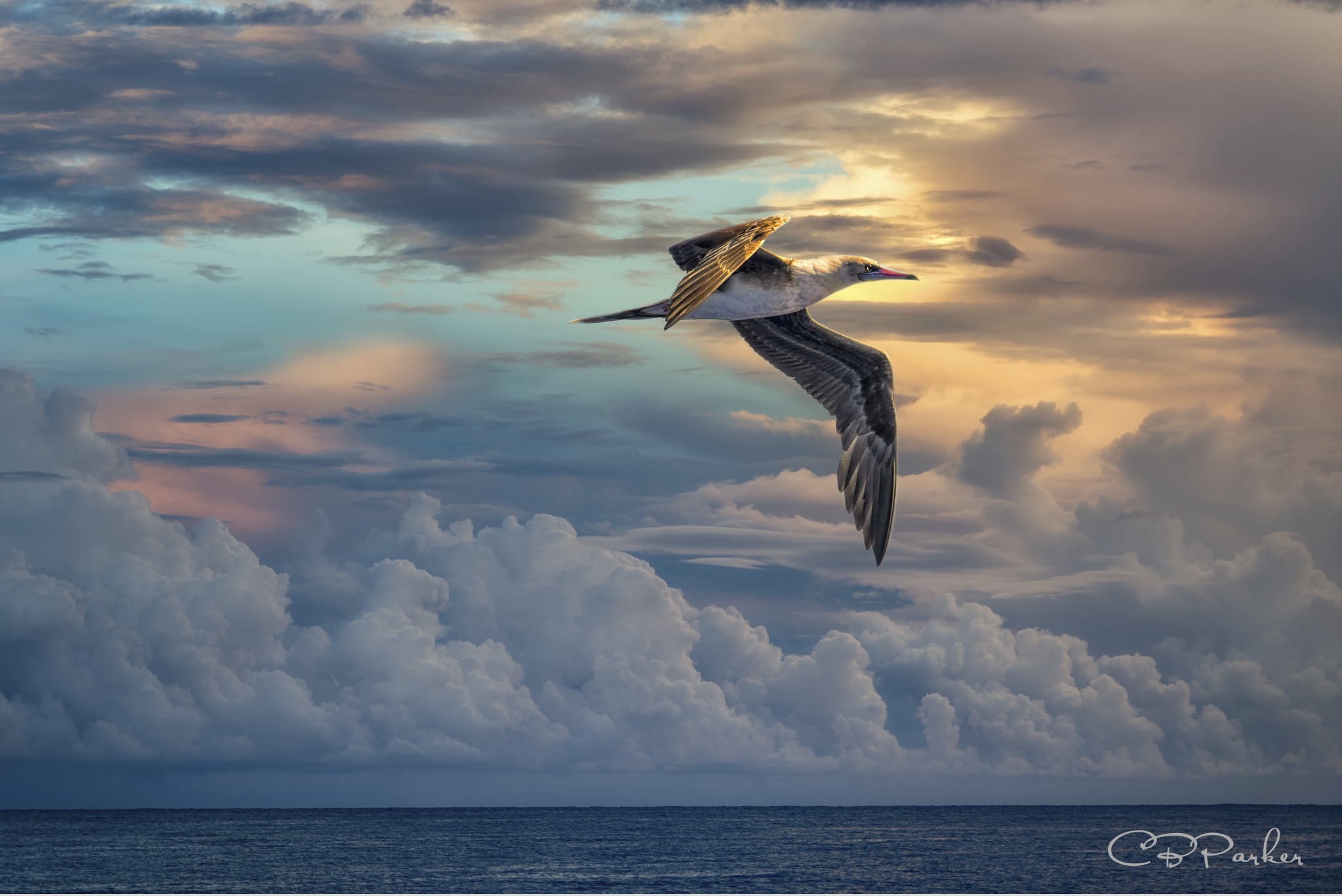
Booby 1Booby 3


I tried photographing the flying fish one morning, a thankless task on a moving boat, but was soon diverted to focusing instead on the boobies that flew by to look us over during their fishing expeditions. And in the first 24 hours in the lagoons of the Russells we were joined seven different times by pods of dolphins.

Two Dolphin s

Energetic Dolphin


We are in the tropics for sure now. We haven’t reached the equator yet (next trip) but we are less than 9 degrees south and the weather is warm and steamy, much warmer than Vanuatu’s refreshing spring air. In the afternoon in full sun it is downright hot and AVATAR’s metal deck is hard on the soles of our feet. Rod has put out our canvas sun awnings to shade the windows and hatches from the heat of the sun. And lucky for us the boat has full air conditioning, probably the only AC around for hundred of miles! This is truly a decadent style of cruising! No wonder yachties on the sailboats decline to speak to us;-) Having experienced both cruising lifestyles, Rod assures us he is a convert and has no desire to revisit the more basic conditions of his early sailing days aboard Uwilhna.

It is, however, perfect weather for enjoying the water. The ocean temperature is about 84 degrees and a snorkel near our first anchorage cools us off beautifully. And the underwater scenery is spectacularly awesome, some of the best I’ve ever seen and one of the draws of the Solomons. Wading distance from shore are shallow reefs, teeming with prolific healthy corals and colorful reef fish bright in the clear water and then plunging precipitously down steep walls into intense blue depths and big fish.

Rainy Afternoon in the Anchorage

Nature even provided us with a generous freshwater washdown on our arrival, rinsing the salt spray off the decks in a drenching downpour at cocktail hour that created its own kind of scenic island beauty.

Photo Gallery includes additional photos:


Night Passage


May 31

It’s midnight and we are en route sailing westward from Fiji to Port Vila, the capital city of Vanuatu. We slipped quietly out of Port Denarau Marina at 5 a.m. Wednesday and are now some 200 nautical miles into our projected 525 nm voyage. Our original destination of Tanna Island has been scratched as the weather forecast is for windy conditions and Tanna offers no protected anchorages.

With three of us on board – Rod, Mayflor and myself – the watch schedule is two hours on, four hours off. I’ve been assigned the 6-8 and the 12-2 (both a.m. and p.m.) time slots so it will be my pleasure to oversee both sunrise and sunset. This evening’s twilight showed us a line of squalls ahead, a signal aboard a sailboat to reef the sails and prepare for sudden wind gusts and attendant excitement during the night. On AVATAR we just motor on, steady and comfortable, knowing that blustery conditions will have little effect.

As well as wind, we are sailing into and out of rain showers, and if I didn’t already know that from the mist on the windows and the damp conditions on the flying bridge (I’m inside AVATAR’s comfortable and dry salon/great room), the radar would remind me via the spattering of colorful speckles surrounding our position on its screen. In the black of night, the main instrument to monitor is the radar screen, looking out for that one steady bright green dot of light (among the myriad transient bright dots) that indicates another ship or boat sharing the ocean with us. There are other instruments to monitor: engine temperature, RPM, track and compass heading, but the radar takes precedence. Every 15 minutes or so a trip top sides is in order to visually scan the horizon for lights that would signify another boat. Another instrument, the depth sounder, stops reading in water this deep, but the electronic charts tell us there are nearly two miles of water between the bottom of our hull and the seabed!

There is a setting half moon dead ahead hiding in the broken clouds and AVATAR is sailing straight down a path of moonlight cast on the shiny black surface of the night sea. The perception is of great velocity, a rocket ship flying through outer space. The reality is that we are traveling at 10+ knots, a respectable speed for an ocean-going yacht but ashore it would invite honks from irritated drivers in a school zone! The squalls have been accompanied by confused seas and the boat has a pitching corkscrew motion as she works her way in and out of the steep swells. The dinnerware is clattering in the cupboards.

Rod is concerned that the stabilizers are in jeopardy. These are hydraulically controlled winglets attached to the hull below the waterline that actively work to smooth out the ride of the boat, dampening any tendency to pitch and roll. They are whining loudly under load in this sea and he worries one is overheating. If we have to shut them down our trip will become much more adventuresome. So far, however, they continue to do their job.

Between my night watch shifts I retire to my comfortable bed in the master cabin. Here my ear on the pillow is only a couple of feet away from the aluminum hull as it skates across the water. I hear the reassuringly steady thrum of the diesel engine, the slap of water against AVATAR’s underbelly, the swoosh of waves foaming along her sides. Periodically a wave smacks the side of the boat, sending a shower of salt spray over the deck. Sleep is light and semi-aware. Dreams are of sailing, Vanuatu and stabilizer repairmen!

Now it’s 6 a.m. and the moon has set, the storm clouds have cleared away, and the night sky is full of stars. They are starting to fade as the promise of dawn glows dimly on the horizon behind us. The stabilizers continue to do their job. The radar will no longer be needed for ship spotting, the ocean swells will immediately look smaller by light of day. The coffee pot will heat up, my watch will end, and I’ll transfer my attention to a good book for a few hours. This coming day, another night, and a third morning at sea still lie ahead before we make our arrival in Port Vila.

Epilogue: We arrived Port Vila on schedule. The stabilizers continued to function and we have determined via tech support that the problem lies with their ‘noise suppression’ system rather than the stabilizers themselves. The waves did NOT look smaller the next day – they looked enormous and we had some pretty rough seas most of that day. At noon the autopilot steering pump failed, causing complete loss of steering. AVATAR sailed in circles until we switched over to the backup system!


Not An Easy Trip!

Photo by Ivor Wilkins, Offshore Images

AVATAR is now berthed in Whangarei, New Zealand, and scheduled to be hauled out for refit on November 1. The 1,100 mile passage from Fiji to New Zealand is notoriously unpleasant as yachts depart tropical waters and head south into New Zealand’s stormy winter weather. Adding insult to injury, the wind direction is generally “uphill” causing the boats to pound uncomfortably straight into the oncoming waves. We did this passage aboard Raven our first season cruising, and Mike likens it to spending five days in a washing machine!

When Nick checked in via email after the first 24 hours passage out of Fiji, he wrote the following:

The 20 knots of SE wind yesterday has eased off to 10-12 knots of Easterly and is looking as though it will remain light for the next 3 days.

So much for weather forecasting, still not an exact science! After two days of relatively light conditions, instead of easing off as anticipated, the winds picked up. AVATAR and crew suffered through two + days (and nights) of force eight gale winds on the nose with gusting force nine (35 to 40 knots gusting to 49) and seas averaging five meters/16 feet!

There’s a silver lining in every cloud, and AVATAR’s designer Steve Dashew took this passage and details provided by an overseas telephone interview with Nick to obtain some realtime performance data. Steve has written a detailed account of his analysis that you may want to read at his SetSail blog, link below.

Meanwhile, to captain Nick and crew Danny, we’re glad you’re safe and sound. Kudos on a job well done!

SetSail Blog: Fiji to New Zealand – FPB 64-1 Avatar Picks Up Some Valuable Force Nine Data

Photo by Ivor Wilkins, Offshore Images

Photo by Ivor Wilkins, Offshore Images


Passage Day 1

AVATAR is headed to New Zealand for R&R and a bit of a facelift. Also it is nearly the official end of cruising season in Fiji. Cyclone season starts up soon and there will be a mass exodus of cruising yachts, many of them also heading to New Zealand to lay over for the season.

Nick and Danny left Denarau Marina yesterday, stopping by the Port of Lautoka to officially clear out of Fiji. They are now 152 nautical miles on their way with another 900 nautical miles or so to go. Apparently there was a significant delay in Lautoka as the customs officials had mislaid the stamp needed to officially finalize the departure paperwork!

Google Earth Link

If you have Google Earth you can click on the Google Earth link to see an interactive view AVATAR’s last posted position. This will download a .kml file to your downloads folder. Double click on it to open in Google Earth to get a “fly by” view of AVATAR’s last reported location. You’ll have to zoom out – there’s a lot of ocean out there!

Or just click on the photo for an enlarged static view.


Continuing On…

Captain’s Log

Mar 16 – We are now on a mooring at Marina Taina…………….progress !!! no more room to anchor the whole area is now taken up with moorings………the progress here is quite outstanding after 2 years of absence. The wind last night was a real pain………30knts from the south, but moved around to the se as we approached, I guess one day of headwinds in 3500 miles is OK……..We have come to papeete to get washing machine parts, plus gas bottle refill, plus stocking up for your trip. plus i need some boat supplies. It was amazing to go to a ‘real supermarket’ again………..wot a selection………but as you will recall at a huge price……….its unbelievable wot things cost here…………so be prepared for our shopping bill.

Mar 22 – Yap sounds fiery in Tonga……..We had tsunami warning here…….police came on jet skis and told all the yachts……..we were at supermarket……amazingly only one boat went to sea !!!!!!!!so what’s a warning worth ???

Mar 24 – We will leave Papeete 2mrw at 9am for Moorea and then on to Huahine………Great to leave here, due to the fact we are on the leeward side of the island, there is no wind at all……..so hot hot……it will be nice to be at anchorage in the trades……

Mar 25 - We are anchored in Moorea………5am start 2mrow for Huahine……….We are going to have our arrival party/dinner at the restaurant overlooking the boat 2mrow night……..We have saved the party for our arrival in the Leeward Islands….the completion of this part of the journey, 3800nm from La Paz !!!……now looking forward to what’s next…. our trip !!!


Landfall at Nuku Hiva

last-dayRaven made landfall around midnight (French Polynesia time) last night!  I’m sure the crew is already anticipating a well-deserved big celebration and some nice shore time in one of the most beautiful places on earth!  This Google Earth image shows Raven’s approximately 3200 mile track (in yellow) from La Paz, Mexico, to the Marquesas (marked in green).  The next green marker some 900 miles further on is Bora Bora where Mike and I plan to meet up with the boat mid-April, and the three red place markers are Penrhyn and Suwarrow in the Cook Islands, and Vava’u, Kingdom of Tonga, where we plan to cruise in April-May. That massive expanse of blue water looks much better in person!


By the way, the little volcano icon top left is Mauna Kea on the Big Island of Hawaii.


Continue reading


En route to French Polynesia

feb-24-halfwayRaven set sail last Monday morning from La Paz on her way to the Marquesas in French Polynesia. Here in Tucson Mike and I have been receiving daily email reports from Rod giving us some pertinent details and updated position reports. Our international crew aboard consists of Captain Rod (a native Kiwi), Brit expat and part-time crew member Nick, and Rod’s Filipino wife Geraldine.

Today they passed the halfway mark, sailing into the Intercontinental Convergence Zone (ITCZ) – an exceptionally rainy area near the equator, from about 5° north and 5° south, where the northeast trade winds and southeast trade winds converge in a low pressure zone also known to sailors as the Doldrums .  Here Raven passed through rain and squalls in what sounds like an exciting bit of sailing.
Continue reading


On To Mainland Mexico


Slideshow Mexico 2008

When my alarm woke me this morning, it was to the sight of a blazing sunrise on our port side, while to starboard a full moon still hung in the morning sky. And accompanying Raven through the sea a pod of porpoises leaping and playing in their graceful arcs, their wet bodies reflecting the red rays of the sunrise. Better than a cup of coffee for a nice way start to the day!
Continue reading


The Cape


Slideshow Mexico 2008

Saturday morning we pulled into Cabo San Lucas right at dawn after a high speed run down the last bit of Baja’s Pacific coast. We had been dawdling along in very light winds, only 1-2 knots most of the afternoon, but late in the day came to an abrupt demarcation in the water where the flat glassy sea turned to a rough dark blue with white caps. Sure enough, as soon as we crossed the line, the wind speed jumped into the high 20s and Raven clocked along all night under sail (three reefs in the main and just a hint of a jib) making 9′s and 10′s, and occasionally 11 knots.

We only stopped in Cabo to refuel, and must have arrived as a fishing tournament was getting underway – an entire fleet of fishing boats all went racing out of the harbor simultaneously as we were pulling in. The entire harbor there is a madhouse of activity, even so early in the morning. We had no intention of staying, not only because of the hectic atmosphere but because the overnight fees are the highest in the world – I have been told (but find it hard to believe) $995/night for a boat slip!

So we continued on our way along the cape, past Palmilla, and pulled into a new marina/resort complex still under construction in San Jose del Cabo, a few miles to the east. A much more inviting environment, even though incomplete. More affordable as well! Once safe in our berth with paperwork out of the way, we spent the rest of the morning napping, doing laundry and housekeeping, and other assorted odd jobs. Mike and I explored on foot nearby, and we had a really lovely dinner at a charming restaurant in town named La Panga per recommendation of our Lonely Planet guidebook. We highly recommend it as well, if you get down this way. A romantic outdoor courtyard – a bit chilly but the staff produced ponchos for each of us (we turned down the sombreros). The town of San Jose del Cabo was extremely inviting, with beautiful old buildings, charming inns, inviting shops, and a huge central square and fountain. Lots of tequila-tasting boutiques! We didn’t really get to explore it all that thoroughly, but there was lots to see and enjoy.

Sunday we rented a car and drove some 2 1/2 hours north to La Paz – a beautiful drive through some spectacular mountainous scenery. Our mission was to locate a suitable berth for Raven to spend hurricane season (June 1 – November 1) – our insurance policy stipulates that we are not to be ‘south of La Paz’ in that time frame. Mike and I had been to La Paz last October for a dive trip, so we knew our way around reasonably well, and after visiting each of the three available marinas, settled on the one we thought offered the best protection – and fortunately it appears they will have space for us!

Mission accomplished, we drove back to the cape but via a different route, cutting across the peninsula to the town of Todos Santos on the Pacific side. There we enjoyed a frappucino that would put Starbucks to shame, and then followed the coastal highway home. Right offshore for miles we could see the spouts of dozens of humpback whales – there must have been hundreds of them all together! We have left the gray whales behind in the lagoons of Baja, but now we are coming into the territory where the humpbacks comes to calve and mate. We have seen them repeatedly in the water – yesterday one was playing around laying on its side with both a fluke and half a tail waving in the air.

Monday morning we pulled out of the harbor bright and early to make an overnight voyage to a small island named Isla Isabel, en route to Puerto Vallarta. Along the way we had several humpback sightings, also dolphin encounters, a turtle, and near Cabo we saw small manta rays or similar species leaping high up out of the water.